| Welcome! | Last update: 20/6 2010 View » |
This site is all about the mountains of Sweden (and Norway), which shall henceforth be referred to as fjelds
(see below for rationale). The area in question is very large, and constitutes what is sometimes popularly labelled
Europe's last wilderness. While this can only partially be said to be true, it is a fact that the fjelds –
especially the Swedish ones – are less exploited and simply more remote than other mountain areas like the
Alps. Here, one can walk for days and days without running into any signs of civilization –
or another human, for that matter, depending on the region and time period of choice.
As a consequence quite a few foreign visitors find their way to the fjelds,
and going for tours of various length and difficulty has long been a staple of the Swedish people,
not to mention the Norwegian one. The fjelds hold great natural beauty and make up a unique terrain type with specialized flora and fauna.
There is an extensive network of marked trails in both summer and winter,
and accommodation of differing standard is offered far from any road in many places,
but there are also vast expanses of more or less untouched ground for those who wish to find their own way and camp out
– and it is usually quite possible to combine the two. So there is something for everyone, as it were.
Fjelds and mountains
The mountain range Skanderna, or the Scandinavian Mountains, is a remnant of the mighty Caledonian Mountains that arose hundred of millions of years ago. Because of its ancient roots the cumulative erosion has been extensive to say the least, and as a result the shapes of most of the present-day constituent mountains are not nearly as jagged as those of younger ranges, such as the Alps or the Himalayas, and the height of the peaks is similarly moderate from an international perspective. This difference is upheld in Swedish, where we see berg as a general word meaning "mountain", and fjäll that refers to the domestic (and bordering) mountains high enough to reach above the tree line. The latter word derives from Old Norse fjall, the descendant of which in contemporary English is fell. The meaning of that term is however ambiguous, and in many cases refers to what should be called hills or just highland rather than mountains – and it is mostly found in England. Some regions also recognize fiell or fjell, and then there's the form fjeld, which most likely is a loan from Danish. Having grown up with the berg/fjäll dichotomy, I find it somewhat difficult – for lack of a better word – to employ the word "mountains" when speaking exclusively of Skanderna, and therefore I have settled upon one of the cognates instead. The reason it became "fjelds" in particular is that I first heard of that word in childhood, and it has stuck ever since.
To illustrate the difference, consider the examples below. The picture on the left is most definitely a berg (mountain), and the one in the middle is first and foremost a fjäll (fjeld), whereas the rightmost one could be called either. Note, though, that there are no clear boundaries, and that different persons have different ideas of what to call what; I'm sure many people would not even bother to use anything other than berg in Swedish or "mountain" in English, but I'm equally sure that no one would refer to the Himalayas as fjäll.
![]() | ![]() | ![]() |
||
| Lhotse, Himalayas | Mĺskásjgájsse, Kvikkjokksfjällen | Sarek group, Sarek National Park |
The Sámi people
Unbeknownst to some, Sweden has an aboriginal population in the form of the Sámi people. The region that the Sámi inhabit – called Sápmi – is, however, not constrained to Sweden, but extends through parts of Norway, Finland and Russia as well, and here they have lived since the last ice age, before the present majority population found their way to the area. Originally they made a living hunting and fishing, but at some point they began focusing on one type of prey in particular: the reindeer, which was eventually domesticated to some degree, and in the 17th century reindeer husbandry had become the main source of income for most Sámi. Today this traditional occupation is still the hallmark of the Sámi people – at least as far as public perception is concerned – but of the about 20,000 Sámi that live in Sweden (out of a total of about 80,000 throughout Sápmi) only about 4500 are reindeer herders – the rest have "normal" jobs, and most of the reindeer herders also do other things on the side.
The reindeer are deeply linked to the fjelds, and so are the Sámi. For thousands of years the latter have followed the natural rhythm of the former, moving between highland and woodland with the change of the seasons. Consequently the Sámi have acquired profound knowledge of the nature and climate of the North – they had no choice if they wanted to survive, as conditions can be pretty harsh. They have not stayed on the sidelines in the industrial age, though, so nowadays they utilize modern equipment like snowmobiles and helicopters in managing their reindeer; the last rajd (reindeer-powered move) took place in the 1950s and the traditional huts have mostly been abandoned for houses of contemporary make. But make no mistake – the fjelds are still the domain of the Sámi.
Like many other nomadic peoples the Sámi ran into trouble with fledgling nations wanting to lay down borders, and as always it was the nomads who were forced to yield to their "new masters". In the 17th century the Kingdom of Sweden concentrated on conquering the northern parts of Scandinavia for real, and one of its main tools for this purpose was the Christian church. The original natural religion of the Sámi had up until then coexisted peacefully with Christianity, but with the backing of the state the church started a crusade of sorts, desecrating their ancient sacred grounds, burning their ceremonial drums, and forcing them to attend services in churches far away from their dwellings. Around the turn of the previous century the Swedish government was becoming concerned that the Sámi were getting too assimilated into society, and the mantra Lapp shall be Lapp became the guiding principle of an educational system that would guarantee the continued inferiority of the reindeer herding people – the woodland Sámi were given no particular thought.
For in full accordance with the history of the mastery of the White Man over aboriginal peoples all over the world, the Sámi were long regarded as a lesser race, and their way of life viewed as primitive and uncivilized. Time after time they have been subjected to aggression – not of war, but of the intrusion of industry into sensitive areas with a living history, always in the all-powerful name of Progress. The prime example of this is of course the extensive construction of hydroelectric plants in the northern rivers, a process which destroyed vast areas that the Sámi had inhabited in peace much longer than anyone can remember. It drowned invaluable cultural traces, and needless to say compelled entire tribes to flee the rising waters. Also for other reasons many Sámi were relocated by force, and much has been lost, both substantial and insubstantial. To cut a long, sad story very short, both the Swedish church and the Swedish nation have a lot to be ashamed of.
Nowadays, however, things have seen a drastic change; even though some of the old xenophobia and Lapp shall be Lapp
can still be found here and there, the Sámi are generally regarded as a valuable addition to Swedish culture.
Earlier young Sámi may have wanted to hide their ancestry, but now most are proud of it instead,
and it is not at all uncommon to see the traditional kolt dress on school graduation ceremonies and the like in places like
Jokkmokk or Kiruna. And, of course,
many Sámi run business geared towards tourism in the fjelds, offering great natural wisdom and a taste of the traditions of yore.
In a way we have now come full circle, only this time the people of the high north can receive their neighbors in a mutual
setting of peace and respect.
The Sámi language(s)
The Sámi language is actually a group of closely related languages in the Finno-Ugric family, but for classification purposes they are regarded as dialects – or varieties – of one language. These sub-languages are in turn grouped into three main divisions: East Sámi (Russia and Finland), Central Sámi (Finland, Norway and Sweden) and South Sámi (Norway and Sweden). The boundaries between these groups cut straight across national borders, but they are not in any way sharp or rigid. In Sweden the main varieties are North Sámi, Lule Sámi and South Sámi, ordered by number of speakers, but there are also some smaller dialects that are close to extinction. Speakers of adjacent varieties can usually understand one another, but the longer the distance the greater the differences. The relationship between Lule Sámi and North Sámi might be likened to that of the Scandinavian languages, whereas South Sámi to Inari Sámi (one of the East Sámi varieties) is more like Swedish to German.
Since the fjelds and other large areas of northern Sweden have been populated and/or utilized by the Sámi for a very long time, the majority of place names in those regions were originally given by them. Such names are almost always descriptive in nature, and with only a basic understanding of some common terms one can learn a lot just from looking at the map. For example, in Sarek National Park we have Gĺrttjevárátja (small waterfall mountains), Jĺgĺsjgaskatjĺhkkĺ (peak between brooks) and Tjievrra (gravel). Other names may have a meaning that requires more analysis, such as Bietsávrre (pine lake) which tells of historic terrain features as there are no pines there now, or Bierikbákte (fool's cliff) which might have earned its name by being notoriously difficult to climb.
In line with the Swedish government's destructive policies regarding the Sámi, their children never got a chance to use their mother tongue in school for much of the 20th century – and could even face punishment if they tried – so by and by the old native language was suppressed or forgotten. Like many other aboriginal peoples the Sámi had no written language, and as a consequence words were changed to various degrees when they were brought into official records, such as road signs and maps, to better suit Swedish vocalization. This process eradicated many a nuance and distinctive mark, and of course served to further devaluate the language. In the late 1960s Lantmäteriet, the Swedish geodesy authority, introduced a special "map orthography" which was employed throughout the fjelds, regardless of the very real and important regional differences. For example, the words for "lake" – jávri, jávrre, jávrrie, jaevrie – were all simplified to jaure. In the 1950s North Sámi was given a uniform orthography which was amended in the late 1970s, South Sámi was standardized in 1978, and Lule Sámi got its official writing system as late as 1983. Through a series of decisions by Lantmäteriet since then, based upon a United Nations resolution from 1972 about the status of minority languages, these orthographies have found their way onto the maps as well, which now finally reflect the original names in an accurate manner.
One can bring forth several reasons as to why adopting these name forms also "for personal use" may be a good idea:
As for myself, I find merit in all of the above, so the decision was easy for me.
See format notes for more information.
Visiting the fjelds
The fjelds, like most of Sweden, are freely accessible to anyone under Allemansrätten, which literally means Everyman's Right, but it is more formally known as the Right of Public Access to the Wilderness. This right has ancient roots, and since 1994 its validity is enforced in the Swedish constitution. It grants the people – any people – the privilege of free roaming across lands which are not specifically marked as residential, including the right to set up temporary camp and to pick flowers, mushrooms and berries provided that they are not red-listed, regardless of who owns the land. But as usual, with freedom comes responsibility, and there are a number of prohibitions that are also part of Allemansrätten, adequately summed up in the simple phrase "inte störa – inte förstöra" ("do not disturb – do not destroy"). Regional regulations may also restrict what is allowed in the first place, such as bird sanctuaries or the ban on tenting in Abisko National Park. But other than that, the fjelds are open to anyone, anytime.
General hiking in the fjelds requires no special equipment other than regular camping gear, and if one chooses to hike between cottages only the demands are lowered further still. Be sure to bring stuff that can withstand rain and wind of the more severe variety, though, as such conditions are commonplace. It is, however, also entirely possible to make "harder" tours, for example on the many glaciers – but that does require special equipment and, first and foremost, knowledge. Most peaks can be reached without climbing skills, but there are a handful that require such (still a cakewalk by international standards, though). The waters are clean, so any rill, stream, river, lake or sizeable pond will do nicely for drinking. In May the spring flood makes hiking more or less impossible, but skiing may still be done in higher areas. The tourist season starts in the middle of June when the plants blossom, but something else which also arrives is the mosquitos, which are not to be discounted. The second half of July and the first half of August constitute the high, but after that visitors – and the mosquitos – grow more sparse. September comes with an explosion of autumn colors, and water levels are as low as they get, but the risk for snow is also appreciable. The following period is generally inhospitable and in midwinter the days are short and the cold is usually severe, so the skiing season is delayed until the middle or end of February, as far as STF is concerned. The light progressively grows, and in April it can be rather warm and sunny – but this time of year the weather is usually fairly unstable. Winter tours in the fjelds place higher demands on visitors, as the cold winds and blizzards can quickly turn a situation life-threatening, but with some common sense and proper equipment it is a joy gliding across the silent white lands, as the snow and ice often facilitate progress.
In short, the fjelds offer a wide range of challenges and opportunities and are mostly to be regarded as friendly, but one should always be respectful of them. The weather is notoriously prone to very sudden changes, and the extremes can be extreme indeed – especially in winter. It is a simple matter of being prepared for what might come to pass, so that one can savor all the other times when the sun shines from a clear sky upon a tract of raw Nature extending to the horizon – and beyond.
![]() |
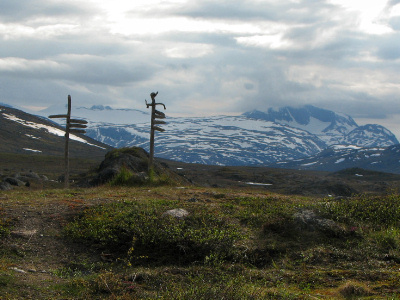
| The intersection of Neasketvággi and Čeakčavággi, Kebnekaise area |


Hits since 30/8 2006:
| 2652 |